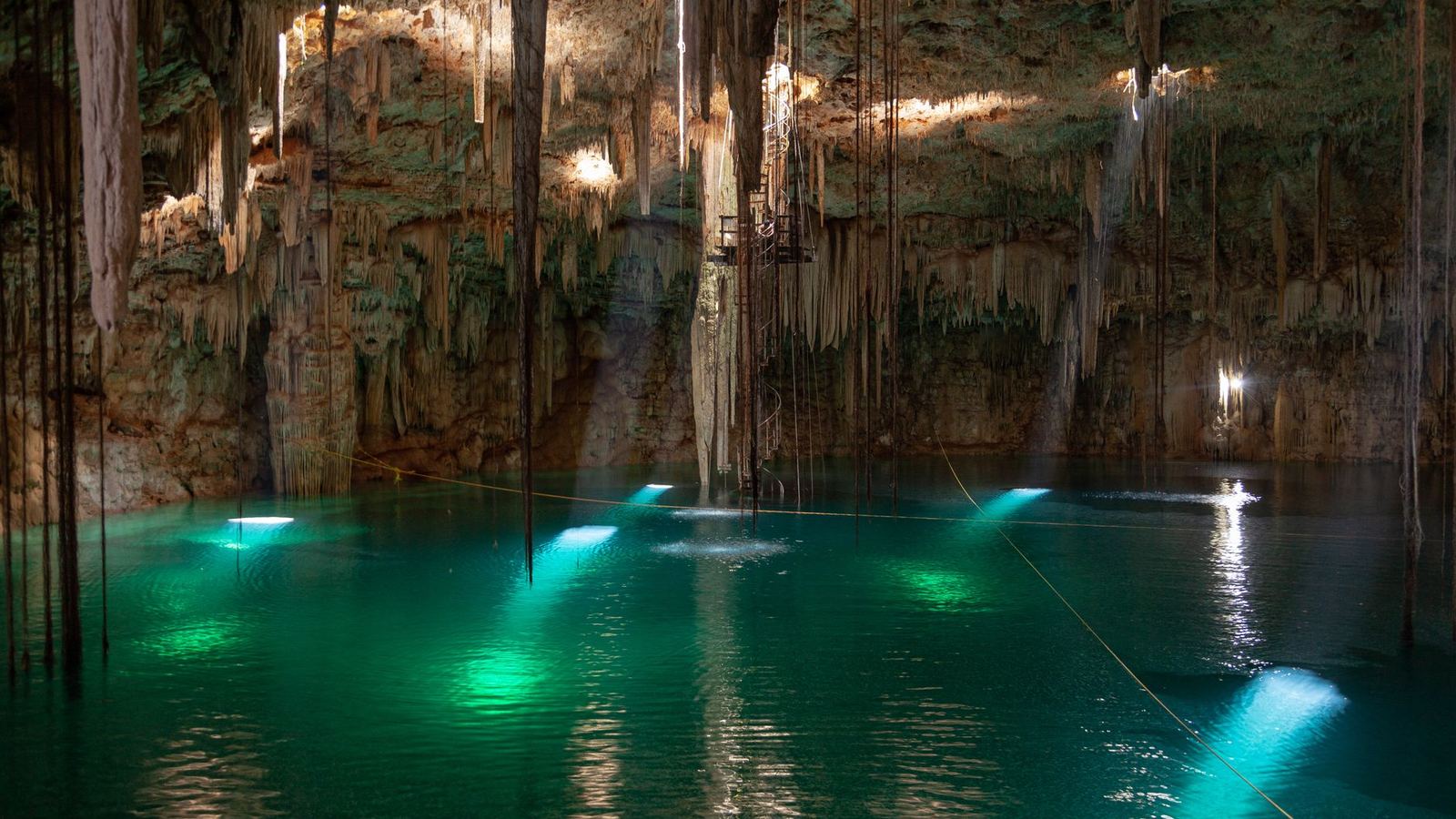
A cenote is a collapsed limestone sinkhole filled with groundwater, and the
peninsula has thousands of them. Some are lagoons with a shallow shelf and
sunlight on the bottom. Some are a 40-metre shaft that divers train for. Both
are called cenotes, both appear in the same photo galleries, and only one of
them is a morning out with a six-year-old.
The tour that has an age limit
The best-documented option from Cancún is Xenotes Oasis Maya, run by Grupo
Xcaret. Everything here is from their own pages, checked on 4 September 2026,
because it is the rare operator that publishes its restrictions plainly.
- Minimum age six. The booking page states it outright;
the FAQ softens it to "not recommended for children under 6 years of
age". Either way, if you have a four-year-old, this trip is not the
one.
- The zip line needs 1.40 m and 40 kg. So a child can be
old enough for the tour and still too small for one of its four
headline activities. Worth knowing before you promise it.
- Children 6 to 11 get 25% off the adult ticket.
- About nine hours including transfers, Monday to
Saturday, hotel pick-up between 8 and 10 in the morning. Four cenotes,
roughly 45 minutes at each, van rides in between.
- Included: life jacket, snorkel mask, rappel gear, kayak and inner tube,
towels, showers and changing rooms, and a jungle picnic.
- "Life jacket is mandatory during all water activities."
Their words.
- Sunscreen: only products containing titanium oxide and zinc
oxide.
Nine hours is a long day. It is the right shape for children of eight and
up who like being thrown at things, and the wrong shape for a five-year-old,
who is not eligible anyway.
The route you can drive yourself
The nearest concentration of cenotes to Cancún is the Ruta de los Cenotes:
the road that runs inland from Puerto Morelos towards the village of Leona
Vicario, starting about five kilometres outside Puerto Morelos, with more than
sixty cenotes along it. Guidebooks put the turn-off around half an hour south
of Cancún, and the cenotes themselves another twenty minutes or so of driving
in. Treat that as an order of magnitude, not a timetable.
Here is the useful reversal for anyone who read
the airport
guide: the Hotel Zone is a strip joined to the mainland at both ends, and
the southern end is the one that feeds onto Highway 307 towards Puerto
Morelos. The hotels that lose on the airport bus —
Royal Solaris and
GR Solaris down at kilometres 19.5
and 20.5 — are the ones best placed for a cenote morning.
The shape of the hole is the whole decision
Puerto Morelos publishes what each of its cenotes actually is, and that
description tells you more than any list of "family-friendly" picks.
Cenotes named along the Ruta de los Cenotes, with the
characteristics the destination publishes for each.
| Cenote | Type | What is published |
|---|
| Sol y Luna | Two open | One in full sun, one quieter |
| Verde Lucero | Open | Zip line, jump platforms |
| Las Mojarras | Open | Largest on the route, 67 m across |
| Blanca Flor | Open | Zip lines, 14 m jump tower |
| La Noria | Open | 18 m deep; zip lines, quad bikes, camping |
| Boca del Puma | Two cenotes | Zip lines, quad bikes, horses |
| Siete Bocas | Underground | Seven natural openings |
| Kin Há | Cave | 40 m deep, for diving |
Read that column and the sorting does itself. Open, wide and sunlit is a
swim. Underground and 40 metres deep is not a swim with a child, whatever the
photographs suggest — an overhead rock ceiling changes what a panic in the
water means. The jump towers are a separate question again: 14 metres is a
serious height, and nobody has to jump to enjoy the water.
Four things that catch families out
The water is cold. Cenotes sit at roughly 24–25 °C all year,
because the aquifer never sees the sun. The Caribbean outside your hotel is
26 °C in winter and pushing 30 °C by late summer. That gap of five degrees is
why children who swim happily all week last twenty minutes here. A rash guard
does more good than a towel.
Your sunscreen probably will not be allowed in. Puerto
Morelos asks that anything you wear be biodegradable; Xcaret narrows it to
titanium and zinc oxide only; plenty of individual cenotes ask you to shower
before entering and prefer you wear nothing at all. Sun shirts and hats solve
this in a way that arguing at the gate does not.
Bring cash, in pesos. The route runs through jungle, card
terminals are unreliable, and the cenotes are run by their owners and
ejidos rather than by a company with a price list. Which leads to the
part I cannot tell you honestly: there is no published, current price
list for the individual cenotes on the route. Guides quote figures in
the region of 250 to 400 pesos a head, mostly from a few years ago, and each
site sets its own. Take that as a rough budget to bring, not as a fact, and
expect life jacket hire and lockers to be extra where they are not included.
Check the life jacket before you drive an hour. On the
branded tour it is included and compulsory. On the route it varies site by
site, and a cenote that turns out to rent them by the handful on a busy
Saturday is a bad place to discover your child needs one.
None of these links pay us. If your children are under six, skip the tour,
pick an open cenote with a shallow entrance, go early, and plan on a shorter
swim than you expect — then spend the afternoon back on the beach, where you
can check what the seaweed is doing.